

Operational disruptions – whether caused by cyber incidents, system failures, or natural disasters – can have a serious impact on your bottom line. A 2024 report by Splunk revealed that unplanned downtime costs Global 2000 companies $400 billion annually, or 9% of total profits.1
A business impact analysis (BIA) can help your organization understand these risks before disruption occurs and prepare your teams to respond with clarity and confidence. Read on to find out how to conduct a business impact analysis and why BIA is so important for business continuity.
Business Impact Analysis Definition
A business impact analysis evaluates how various disruptions would affect an organization’s operations. It examines the financial, operational, and regulatory impacts of outages or failures to help businesses prioritize recovery efforts where they matter most.
Rather than focusing solely on technology, a BIA connects people, processes, and systems – providing leadership with actionable insight into what they need to fix. At TMC, we use BIAs as a foundational tool to support resilience, continuity planning, and technology strategy across complex environments, so you always have peace of mind knowing your organization is ready for anything.
Why Does a BIA (Business Impact Analysis) Matter?
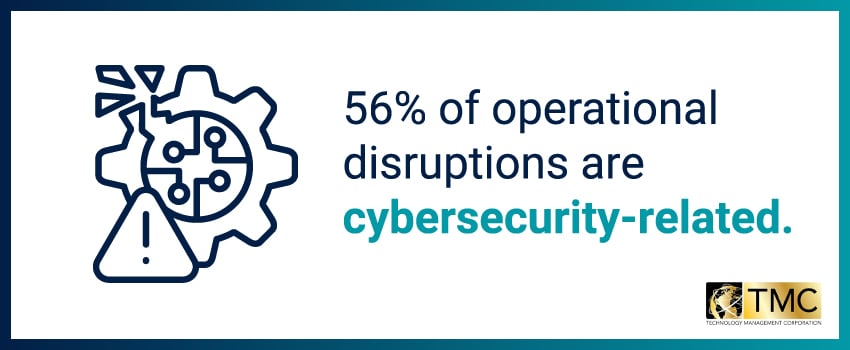
Splunk’s report found that 56% of disruptions are cybersecurity-related and 44% come from app or infrastructure issues.1 For businesses that depend on uptime, the difference between a well-planned recovery and an improvised response can mean millions of dollars.
BIAs help IT and security teams:
- Identify critical business functions and dependencies across departments.
- Establish recovery time objectives (RTOs) and recovery point objectives (RPOs).
- Support continuity of operations (COOP) and disaster recovery planning.
- Align technology investments with business risk and resilience goals.
Because a business impact analysis sample is so thorough, many organizations also rely on them for guidance on meeting compliance requirements tied to NIST, ISO, and sector-specific mandates.
How To Conduct a Business Impact Analysis
While every organization is different, the core steps for conducting a BIA (business impact analysis) remain consistent across industries and company sizes. Here are the basics:
1. Identify Critical Business Functions
Start by documenting the most important functions across your IT, operations, facilities, security, and leadership teams. The goal here is comprehensive coverage, so make sure to involve the people who actually run these functions daily, as they’ll understand nuances that documentation alone can’t capture.
2. Assess Impact Over Time
Disruptions will affect each function differently depending on how long they persist. A network outage may cause immediate revenue loss for an e-commerce platform but also trigger safety concerns for a manufacturing facility or regulatory exposure for a financial services firm.
Document impacts at multiple time intervals, such as 15 minutes, 4 hours, and 24 hours, to determine where recovery speed matters most.
3. Map Dependencies
Identify the technology systems, data sources, vendors, facilities, and personnel required to support each of your critical functions. This step often surfaces single points of failure that would otherwise remain hidden until a disruption strikes.
4. Define Recovery Objectives
Establish RTOs and RPOs based on your organization’s actual tolerance for downtime and data loss. For example, a financial services business may require a 15-minute RTO for its transaction processing systems, while an HR firm might accommodate a 4-hour RTO.
5. Validate and Prioritize
Review your findings with stakeholders to confirm their accuracy and prioritize recovery efforts based on importance.
Not sure where to start? TMC’s consultants guide organizations through these steps to ensure your disaster recovery strategies align with operational reality – not just theoretical models.
What Are Common Business Impact Analysis Sample Deliverables?
A strong business impact analysis sample should include clear, executive-ready documentation, such as:
- Inventory of critical functions with assigned ownership
- Impact assessment tables by time interval
- Dependency maps across systems, vendors, and facilities
- Recovery objectives aligned to business risk
- Actionable recommendations for resilience improvements
TMC focuses on producing BIAs that leadership teams can actually use – supporting continuity planning, funding decisions, and long-term modernization efforts.
Business Impact Analysis Example
A real-world business impact analysis example might involve a healthcare provider evaluating the impact of a network outage.
With a BIA, the provider may find that its most critical function is patient intake and clinical documentation, and its primary dependency is the electronic health record (EHR) system. The immediate impact of these systems going down would likely include delayed care and safety risk, with regulatory exposure and patient backlog causing long-term issues. Thanks to the analysis, they’d find that their top priority is to implement redundant access paths to restore these functions immediately.
For businesses with complex technology environments, such as healthcare, airports, and government agencies, BIAs regularly surface dependencies that were previously undocumented. This visibility allows leadership to address risk proactively rather than reactively.
How a BIA Shapes IT Infrastructure Design for New Buildings
A business impact analysis pays a second dividend on construction and renovation projects: its findings translate directly into IT infrastructure design requirements for the building itself. When the analysis shows that a function cannot tolerate more than minutes of downtime, that tolerance becomes a physical design decision, including redundant riser pathways, diverse service entrances, and equipment rooms with the space, power, and cooling to support failover.
Those requirements need to reach the design team while they can still shape the drawings. A technology consultant for architects carries them into the technology drawing set during schematic design and design development, coordinating them with the architectural and engineering documents before decisions get locked into the CDs. Facilities with complex continuity requirements, such as hospitals, airports, and government buildings, benefit most from this handoff, because their BIA findings tend to demand infrastructure that a standard design would not include.
Organizations planning a new facility alongside a continuity initiative can treat the BIA as an input to both. Learn more about how TMC helps architecture firms connect resilience planning to building technology design.
BIA and IT Infrastructure Design FAQs
Strengthen Your Resilience With TMC
Understanding risk is the first step toward strengthening operational resilience. If your organization is planning continuity initiatives, network infrastructure upgrades, or security improvements, a well-executed BIA provides the clarity needed to move forward with confidence.
At TMC, we ground our approach to business impact analysis in independence, structure, and cross-functional collaboration. Our technology consultants can help you:
- Facilitate stakeholder workshops and data collection
- Align with recognized frameworks and regulatory expectations
- Translate findings into recovery and modernization strategies
- Connect business continuity efforts to infrastructure and AI initiatives
Ready to strengthen your resilience with an expert-led business impact analysis? Contact TMC today.
Sources: