
Every organization relies on technology to operate – and every organization that relies on technology faces risk. According to IBM’s Cost of a Data Breach Report, the average cost of a data breach was $4.4 million in 2025,1 yet many organizations still lack a clear, structured approach to information technology security.
If your company invests in security tools reactively and operates without a cohesive strategy for identifying and managing risk, this guide is for you. Read on to learn what IT security is, why it matters, and how to build a strategy that holds up against the latest threats.
What Is Information Technology Security? IT Security Definition
IT security – short for information technology security – refers to the policies, controls, technologies, and practices designed to protect an organization’s digital assets from unauthorized access, disruption, theft, or damage. Those assets include hardware, software, networks, data, and the systems and people that interact with them.
IT security isn’t a single tool or technology. It’s a discipline that spans technical controls, organizational policy, risk management, and compliance. A strong IT security posture requires all of these elements working in concert.
It’s also worth noting what IT security is not: it’s not a one-time project, and it’s not the exclusive responsibility of an IT department. Effective IT security requires involvement from leadership, operations, legal, HR, and every team that handles sensitive data or mission-critical systems.
Why Does Information Technology Security Matter?
IT security exists because digital systems are both essential and vulnerable. Organizations that don’t actively protect their technology environments face a growing set of consequences.
The business case for IT security has never been stronger:
Cyberattacks Are Increasing
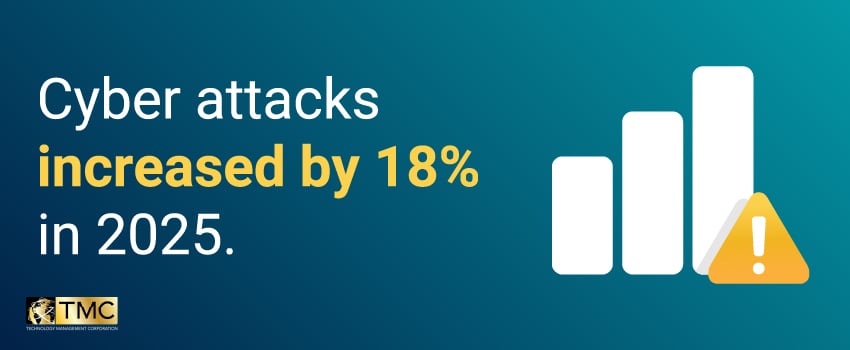
Cyber attacks increased by 18% in 2025,2 and security experts predict that a business will be attacked every 2 seconds through 2031.3 No sector is immune to these threats – healthcare, government, education, and enterprise organizations are all targeted.
Regulatory Requirements Have Expanded
Frameworks like HIPAA, NIST CSF, CMMC, and SOC 2 require demonstrable security controls, and failing to comply means financial penalties, legal exposure, and reputational damage.
At TMC, we offer GRC, Security, & Privacy consulting to help organizations assess their security posture, identify gaps, and build a defensible, compliance-aligned security program – without vendor bias shaping the recommendations.
The Cost of Inaction Compounds
Every unpatched vulnerability, undocumented access control, and unmonitored endpoint is a potential entry point. The longer these gaps go unaddressed, the more expensive they become to remediate.
Stakeholders Expect Accountability
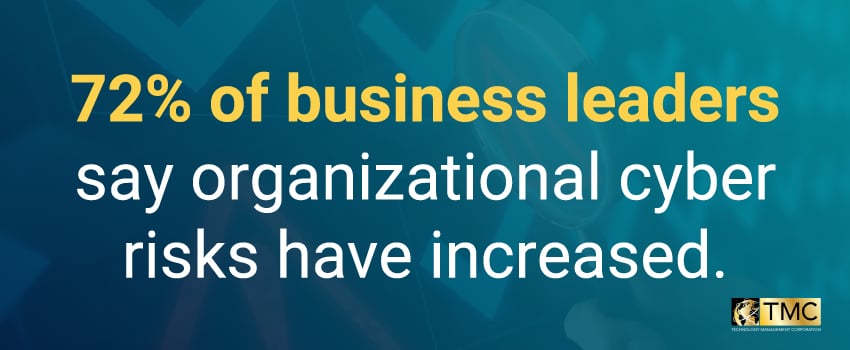
A 2025 report found that 72% of business leaders reported an increase in organizational cyber risks.4 This expectation is shaping investments and business priorities, with stakeholders increasingly requiring evidence of responsible technology risk management.
Information System Security: 3 Core Principles
IT security is built on a framework called the CIA Triad: Confidentiality, Integrity, and Availability.
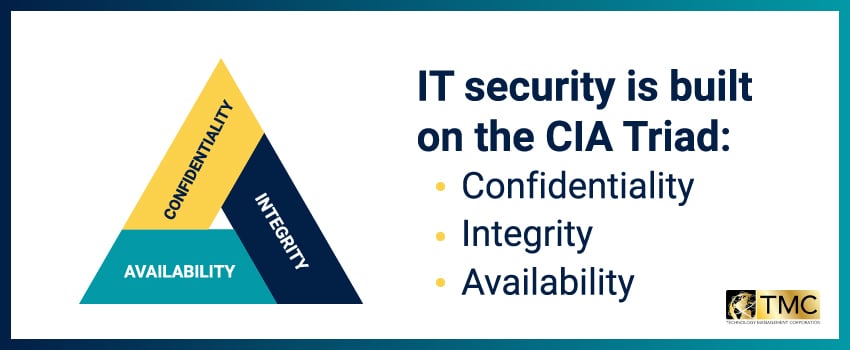
- Confidentiality: Confidentiality ensures that information is accessible only to those who are authorized to access it. Controls that support confidentiality include encryption, access management policies, role-based permissions, and data classification frameworks.
- Integrity: Integrity ensures sensitive data stays accurate and unaltered, except through authorized processes. Controls that support integrity include audit logging, hash verification, change management processes, and database access controls.
- Availability: Availability keeps systems and data accessible to authorized users when needed. Controls that support availability include redundancy, disaster recovery planning, backup policies, and network resilience design.
Together, these three principles guide the design of security controls across every layer of an organization’s technology environment.
What Are the Types of IT Security?
Understanding the types of IT security and how they work together is essential for building a program that protects your organization end-to-end.
Network Security
Network security protects the integrity, confidentiality, and availability of data as it moves across networks. It encompasses both your internal network and the connections that link your organization to the internet, cloud environments, and external partners.
Common network security controls include:
- Firewalls and next-generation firewalls (NGFWs) that filter traffic based on defined rules.
- Intrusion detection and prevention systems (IDS/IPS) that check for and respond to suspicious activity.
- Network segmentation that limits lateral movement if a breach occurs.
- Secure remote access solutions, including VPNs and zero trust network access (ZTNA).
Network security is foundational – and it’s where many organizations have the most significant gaps. TMC’s network infrastructure consulting addresses both the performance and security dimensions of network design, ensuring that your architecture supports your business without creating unnecessary exposure.
Endpoint Security
Endpoint security protects the devices – laptops, desktops, mobile devices, servers, and IoT devices – that connect to your network. Each endpoint is a potential entry point for attackers, and the proliferation of remote work and connected devices has dramatically expanded the attack surface most organizations need to defend.
Endpoint security controls include:
- Antivirus and anti-malware software
- Endpoint detection and response (EDR) platforms
- Mobile device management (MDM)
- Patch management
- Device encryption
The goal is to ensure that every device accessing your organizational systems meets a defined security baseline.
Identity and Access Management (IAM)
IAM platforms control who has access to what within your technology environment – and under what conditions. It encompasses user authentication, authorization, privileged access management (PAM), and the processes for provisioning and deprovisioning access as personnel join, change roles, or leave the organization.
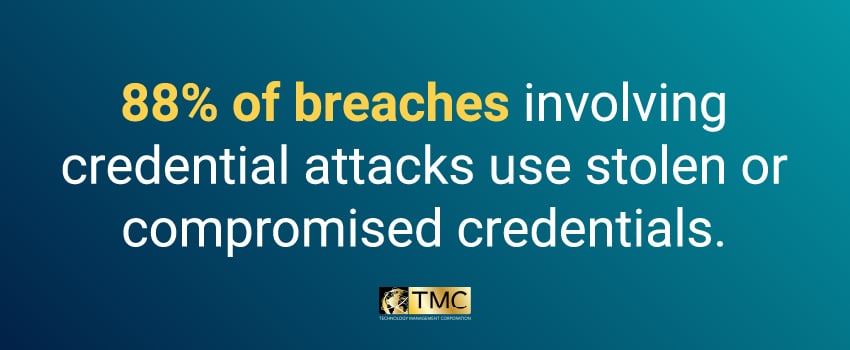
IAM is one of the highest-leverage areas of IT security, with 88% of breaches involving credential attacks in 2025 using stolen or compromised credentials.5 Foundational IAM controls like multi-factor authentication (MFA), single sign-on (SSO), and least-privilege access policies help stop this type of credential misuse.
Application Security
Application security focuses on protecting the software applications your organization builds, deploys, or relies on. Vulnerabilities in applications – including web applications, internal tools, and third-party software – are among the most commonly exploited attack vectors.
Application security controls include secure software development practices, vulnerability scanning, penetration testing, web application firewalls (WAFs), and patch and update management. For organizations that rely heavily on SaaS platforms, application security also includes evaluating the security posture of vendors and managing access to those platforms.
Cloud Security
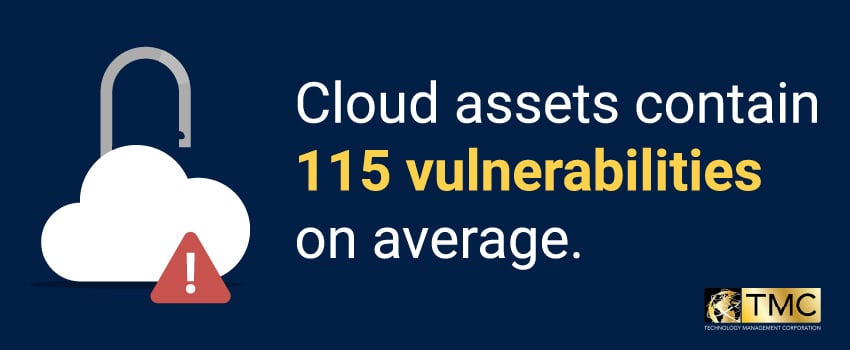
Cloud security has become a critical IT security domain in its own right, with each cloud asset containing 115 vulnerabilities on average.6 Cloud security addresses the unique risks of shared infrastructure, distributed data storage, and the rapid pace of cloud environment change.
Cloud security controls include:
- Identity and access management (IAM)
- Cloud security posture management (CSPM)
- Data encryption at rest and in transit
- Security monitoring across cloud environments
For organizations planning or executing a cloud migration, security considerations should be built into the migration strategy from day one, not added after the fact. Our cloud migration consulting integrates security planning throughout the migration process to reduce the risk of introducing new exposure in the transition.
Data Security
Data security protects information throughout its lifecycle – at rest, in transit, and in use. It includes data classification, encryption, data loss prevention (DLP) controls, and policies governing how data is stored, shared, and disposed of.
Organizations subject to data privacy regulations like HIPAA, GDPR, CCPA, or state-level privacy laws typically must integrate data security as a compliance requirement. Knowing where your sensitive data lives and who can access it is the starting point for meeting those requirements.
Operational Security (OPSEC)
Operational security addresses the processes, procedures, and human behaviors that affect security outcomes. OPSEC controls include security awareness training, incident response planning, change management processes, and third-party risk management.
This is an area where many organizations underinvest. Technical controls only go so far when employees click phishing links, share credentials, or bypass security procedures for convenience.
Physical Security and IT Security: Where Building Design Fits In
Digital controls only protect systems that are physically protected first. Server rooms, network closets, and cabling pathways are all assets an IT security program depends on, and the systems that guard them, including access control, video surveillance, and intrusion detection, fall under Division 28 of a building's design documents.
The strongest security postures treat those systems as part of the design phase rather than a post-occupancy purchase. A security system design consultant defines the access control zones, camera coverage, and monitoring infrastructure while the drawings are still open, and coordinates them with the network infrastructure that carries them. Decisions like where telecommunications rooms sit, how pathways are secured, and how the network supports segmentation all get made during schematic design and design development, when changing them costs a line on a drawing instead of a construction change order.
Organizations planning new facilities or major renovations can fold this layer into the project from the start. Learn more about how TMC helps architects approach security and technology design for building projects.
How To Build an IT Security Strategy That Holds Up
Knowing the definition of IT security and understanding its components is the starting point. Translating that knowledge into a durable security strategy requires a few key commitments:
- Start with a Risk Assessment: You can’t prioritize what you haven’t measured. A formal security risk assessment identifies your biggest vulnerabilities, maps them to potential impact, and gives your leadership team the data needed to make informed investment decisions.
- Align To a Recognized Framework: Aligning your security program to an established framework like NIST CSF, ISO 27001, CIS Controls, or a sector-specific standard provides structure, benchmarking, and a defensible foundation for compliance.
- Treat Security as a Continuous Program: Your technology environment, threat landscape, and compliance obligations all change over time. A security program that isn’t regularly reviewed and updated will drift out of alignment with your actual risk exposure.
- Engage Independent Expertise: Vendor-aligned security recommendations often reflect what vendors have to sell, not what your organization actually needs. Independent, vendor-neutral consulting provides the objectivity needed to make decisions based on your risk profile.
TMC’s team works with organizations across healthcare, government, education, and enterprise sectors to evaluate security posture holistically – connecting the dots between network design, access controls, compliance requirements, and operational practices to build programs that actually reduce risk.
IT Security and Security System Design FAQs
Strengthen Your IT Security Posture With TMC
Whether your organization is building an IT security program from the ground up, preparing for a compliance audit, or looking to close specific gaps in your current posture, the right approach starts with a clear picture of where you are and where you need to be.
At TMC, our GRC, Security & Privacy practice delivers vendor-neutral security consulting grounded in frameworks that actually hold up – NIST, HIPAA, SOC 2, CMMC, and more. We’ve been helping organizations across healthcare, government, education, airports, and enterprise environments build more secure technology programs since 1987.
Ready to take a clearer look at your IT security posture? Contact the TMC team today.
Sources:
- https://www.ibm.com/reports/data-breach
- https://www.checkpoint.com/security-report
- https://www.sentinelone.com/cybersecurity-101/cybersecurity/cyber-security-statistics
- https://reports.weforum.org/docs/WEF_Global_Cybersecurity_Outlook_2025.pdf
- https://www.verizon.com/business/resources/T231/reports/2025-dbir-data-breach-investigations-report.pdf
- https://orca.security/wp-content/uploads/2025/06/2025-State-of-Cloud-Security-Report-v2.pdf