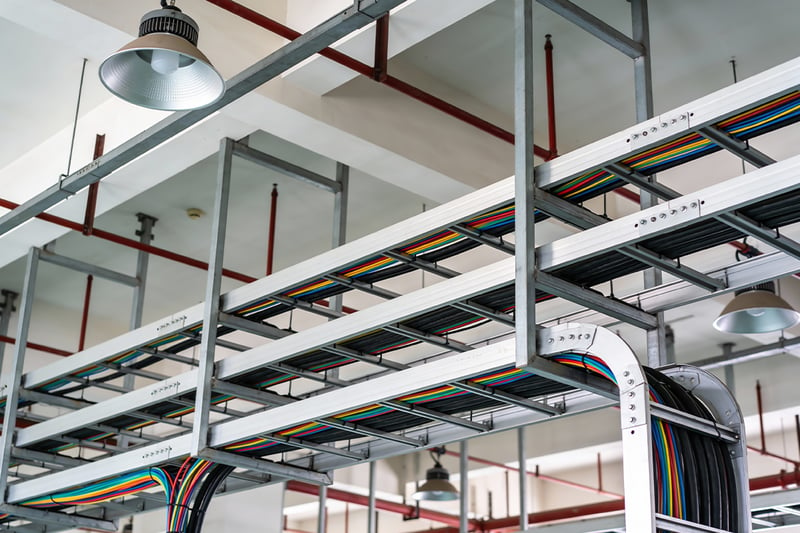

A low-voltage consultant is a design professional who defines, documents, and coordinates the low-voltage systems required for a commercial building project. Their scope covers structured cabling, audiovisual systems, access control, distributed antenna systems, and other communications infrastructure – the full range of technology systems that fall under MasterFormat Division 27 and Division 28.
On building projects where these systems need to be coordinated during design development, a low-voltage consultant produces the drawings and specifications that contractors use to price and build the work accurately. Read on to learn which systems a low-voltage consultant covers, how the role differs from an MEP engineer, and why early engagement matters.
Who Designs Low-Voltage Systems?
Low-voltage systems include any electrical system that operates at 50 volts or below and is not part of the building's primary power distribution. On commercial building projects, the systems a low-voltage consultant most commonly covers are these:
- Structured cabling and telecommunications infrastructure (Division 27)
- Audiovisual systems, including displays, audio, video conferencing, and building-wide AV (Division 27)
- Access control and electronic security systems (Division 28)
- Distributed antenna systems (DAS) for cellular coverage
- Building automation and intercom systems
Each of these systems carries physical requirements, including conduit routes, equipment room space, ceiling pathways, power and cooling loads, and structural backing, that need to be coordinated with the architectural and MEP drawings before construction begins. A low-voltage consultant's primary job is to make sure those requirements are reflected in the construction documents.
Low Voltage Consultant vs. MEP Engineer: Low Voltage Design Building Project Role
The most common misconception about a low-voltage scope is that the MEP engineer always covers it. In most cases, if the MEP firm doesn’t have a technology division in-house, their scope covers power distribution, conduit rough-in, and lighting – not the design of the communications systems that occupy that conduit.
An MEP engineer will typically stub out conduit based on general assumptions about technology load. A low-voltage consultant will specify exactly what conduit is needed, where it terminates, and what it carries. Those two scopes are complementary, not redundant.
[MEP engineers design the physical IT infrastructure. Low voltage consultants design what runs through it.]
The MEP engineer designs the physical infrastructure, while the low-voltage consultant designs what runs through it. Both are needed for the construction documents to be complete. On projects where the low-voltage consultant's scope is missing, the MEP engineer's assumptions about conduit might not match the systems the technology contractors need to install.
Why Does Early Engagement Matter?
The earlier you engage a low voltage consultant, the more value their coordination work can deliver. At SD, they establish telecommunications room locations, backbone cabling pathway strategies, equipment room sizing, and power and cooling requirements – decisions that influence the architectural floor plan and the MEP engineering scope.
At design development, the low voltage consultant produces the coordination drawings for conduit routing, ceiling pathway plans, equipment room layouts, and power outlet locations. Those drawings coordinate with the architectural, structural, and MEP drawings to produce a complete set of construction documents that contractors can price and build without gaps.
Engaging a low voltage consultant at or after construction documents are issued eliminates most of the coordination value. The architectural and MEP decisions have already been made without IT/low-voltage input, and the consultant's role becomes reactive – identifying conflicts that could have been prevented rather than preventing them.
What Does a Low Voltage Consultant Deliver?
The primary deliverable is a set of construction documents: low-voltage drawings, CSI Division 27 and Division 28 specifications, and schedules. These documents describe every system the project requires, where it's located, how it's connected, and what performance standard it must meet. They coordinate with the full design set and enable multiple contractors to bid the low-voltage scope accurately against the same requirements.
Beyond the documents, a low voltage consultant typically provides construction administration services – reviewing submittals from the low-voltage contractors, responding to technology-related RFIs, and confirming during site visits that systems are being installed to the design intent. That construction administration phase is where the specification gets protected through installation.
Reach out today to learn more about how TMC provides low-voltage design services for architectural projects.