

TL;DR
- A complete technology design services scope covers all technology systems the project requires, typically Division 27 (Communications) and Division 28 (Electronic Safety and Security), and produces coordinated construction documents for each.
- Deliverables are organized by design phase – technology program at SD, coordination drawings at DD, vendor-neutral specifications at CDs, and construction administration through project closeout.
- Common scope gaps include systems that are excluded without being clearly assigned to another consultant, phases that are excluded, and specs that are proprietary rather than performance-based.
- Technology design services scope should be established before schematic design begins – not added to the project after the design is underway.
- The right scope matches the project's technology complexity: a simple commercial office has different requirements than a campus, healthcare facility, or government building.
Why Does Building Project Technology Scope Matter?
A technology design services scope that's incomplete doesn't just create bid ambiguity. It creates a chain of downstream problems that compounds from design development through construction and into project closeout. Systems that aren't covered by any design consultant get scoped by contractors at bid – with assumptions that rarely match the project's actual requirements. Phases that are excluded from the scope leave the project without professional oversight at the moments when oversight matters most.
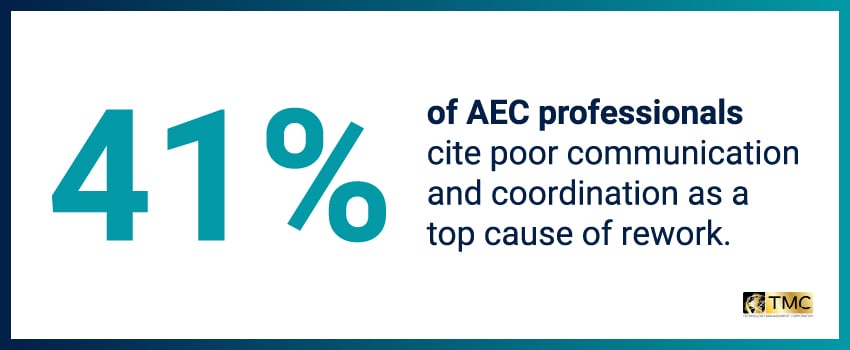
The stakes here aren't abstract. Industry research found that 41% of AEC professionals cited poor communication and coordination as a top cause of rework, up from 37% a year earlier.1 Scope gaps are where much of that coordination failure starts, since a system nobody was assigned to design is a system nobody coordinates. Getting the scope right at the start, before schematic design begins, is the most efficient way to prevent those problems.
In this blog, we'll explain why the technology scope matters, what a complete scope covers, the common gaps that create downstream problems, and how to define the scope before those gaps form.
What Should Be in a Technology Design Scope?
On a complex institutional or commercial project, the Division 27 systems are effectively always in scope, since nearly everything else depends on them. At TMC, we’ve found that what gets added is driven by building type.
For example, a healthcare facility may pull access control and nurse call integration to the center of the scope, while a government building or airport might see Division 28 security and public safety DAS as the most coordination-intensive part of the engagement. Matching the scope to the project this way is what keeps it complete without padding it with systems the project doesn't need.
In general, a complete technology design services scope for a commercial building project will typically include these systems:
Structured Cabling and Telecommunications
Structured cabling and telecommunications infrastructure is the foundation of Division 27 scope. It includes the physical backbone – entrance facilities, equipment rooms, backbone cabling, telecommunications rooms, horizontal cabling, and work area components – that supports all other technology systems in the building.
Audiovisual Systems
Audiovisual system design can include:
- Conference room AV
- Building-wide digital signage and paging
- Lobby and common area AV
- Specialty systems like auditorium AV or stadium systems
On projects with significant AV requirements, AV system design is among the most coordination-intensive elements of the scope.
Network Infrastructure
Network infrastructure includes the active equipment design that sits on top of the structured cabling backbone:
- Switching architecture
- Wireless coverage planning
- Network segmentation
Active equipment design coordinates with the cabling design to ensure physical infrastructure supports the network architecture.
Access Control and Electronic Security
Access control and electronic security systems (Division 28) include:
- Access control door hardware integration
- Video surveillance
- Intrusion detection
- Mass notification
On projects where physical security is a significant requirement, Division 28 scope is as complex and coordination-intensive as Division 27.
Distributed Antenna Systems
Distributed antenna systems (DAS) provide in-building cellular and wireless coverage. DAS design coordinates with the structured cabling backbone for pathways and equipment room co-location.
What Are Common Technology Design Scope Gaps?
In our years working alongside architecture firms, the TMC team has found that the most common gaps in technology design services scope follow a consistent pattern. These are:
- Systems that are present on the project but not explicitly included in the technology consultant's scope get scoped by contractors at bid – producing assumptions, allowances, and change orders.
- Construction administration that's excluded from the scope leaves the project without professional oversight of contractor submittals and RFI responses.
- Specs that aren't explicitly required to be performance-based and vendor-neutral allow consultants to produce proprietary specifications that limit competitive bidding.
The clearest way to prevent these gaps is to establish the scope before design begins, with explicit statements of what's included, what's excluded, and what deliverables are expected at each phase. A scope defined after gaps have already been discovered costs more to close than a scope that was complete from the start.
How Do You Write a Complete Technology Design Scope?
A strong technology design services scope starts with something most technology RFPs leave out: a clear statement of the business problem the technology is meant to solve. When that objective isn't clarified, whether the design actually addresses it becomes a matter of chance. From there, a complete scope defines the systems precisely enough to be estimated, accounts for the adjacent systems that are easy to forget, and names the phases the consultant is responsible for.
A complete technology design scope should address each of the following:
- Business Objective: What the technology needs to accomplish for the owner, stated plainly rather than assumed to be self-evident.
- Sufficient Detail to Estimate the Effort: The information a consultant needs to size the work, such as the number of existing data ports or employees for a network design.
- Adjacent Systems: Cellular and public safety DAS, building automation, and the other systems that the core design depends on but that RFPs routinely omit.
- Security Across All Systems: Not just the data network and phones, but building automation and the other ancillary systems that are frequently left out of security planning.
- Current Architectures: A design built on today's standards rather than the obsolete approaches that still appear in many RFPs, especially for less broadly understood systems like DAS and AV.
- Construction Administration Scope: An explicit definition of the consultant's role during construction, which is the phase most often left undefined.
A scope that covers these points produces more accurate proposals, a cleaner engagement, and far fewer gaps to discover once the project is underway.
Frequently Asked Questions
What should be in a technology scope for a building project?
A complete technology design services scope for a building project should cover all technology systems the project requires – typically structured cabling, AV, network infrastructure, access control, DAS, and related Division 27 and Division 28 systems – and produce coordinated construction documents at each design phase.
Deliverables should include:
- A technology program at SD
- Coordination drawings at DD
- Vendor-neutral specifications at CDs
- Construction administration services through closeout
Exclusions should be explicitly stated to avoid scope gaps at bid.
How do you write a technology design RFP for a building project?
A technology design RFP should describe the project type and technology complexity, list the systems the scope should cover, specify the deliverables required at each design phase, require vendor-neutral performance-based specifications, and request examples of construction documents from comparable past projects. The RFP should also ask consultants to identify any systems or phases they would exclude from their standard engagement – that information is often more revealing than what they include.
What happens when technology design scope is incomplete?
When technology design scope is incomplete, systems that aren't covered by any design consultant get scoped by contractors at bid. Those contractors use assumptions and allowances that rarely match the project's actual requirements – producing change orders when the gaps are discovered during construction.
Phases excluded from the scope leave the project without professional oversight at the moments when coordination and review matter most. The downstream cost of scope gaps is almost always higher than the cost of addressing them at the start.
When should the technology design scope be defined?
The technology design scope should be defined before schematic design begins. Establishing it up front means the technology program, infrastructure requirements, and system coverage are built into the design from the first phase rather than retrofitted after the architectural and MEP design is underway. A scope added mid-project has to work around decisions that were already made without technology input, which is where avoidable coordination gaps and change orders come from.
How Can an Architectural Technology Consultant Help?
An incomplete technology scope rarely announces itself at the start of a construction project. It surfaces later, as a system nobody designed, a submittal nobody reviewed, or a change order for work that should have been in the documents all along. The way to avoid that is to define the scope completely before schematic design begins, with an architectural technology consultant who knows from experience where the gaps tend to hide.
TMC has simplified technology design for architects for more than 35 years, from schematic design all the way through construction administration. We help architects and building owners define a complete scope up front, produce the coordinated drawings and vendor-neutral specifications that hold up at bid, and stay engaged through construction to keep the installed systems true to the design.
If you're defining the technology scope for a project and want to close the gaps before they reach the field, get started with TMC today.