

Every organization faces cybersecurity risk. But without a clear picture of where your vulnerabilities are and what they could cost you, your security spending becomes guesswork.
The global average cost of a data breach reached $4.44 million in 2025, with the United States seeing even higher costs at $10.22 million on average.1 For most organizations, that financial impact would be catastrophic.
A cybersecurity risk assessment closes the gap between knowing you have exposure and understanding exactly what to do about it. Read on to learn what a cybersecurity risk assessment is, why your business needs one, and how to conduct one that’s actually actionable.
What Is a Cybersecurity Risk Assessment?
A cybersecurity risk assessment identifies, analyzes, and prioritizes the risks to your organization’s information systems, data, and technology infrastructure. The goal isn’t to build a list of every conceivable threat, but to give your leadership team a clear, evidence-based picture of where you’re most vulnerable and what those vulnerabilities could cost you.
When done well, a risk assessment in cybersecurity becomes the foundation for every security decision that follows: what you invest in, what you fix first, and how you demonstrate due diligence to regulators, insurers, and stakeholders.
Risk Assessment in Cybersecurity: Key Terms
Before walking through the cybersecurity risk assessment steps, it helps to understand the fundamental concepts that shape how you identify, measure, and respond to threats. These include:
- Assets: Everything of value that could be compromised, including data, systems, applications, hardware, and the people who interact with them.
- Threats: The actors or events that could exploit a vulnerability, such as ransomware, phishing campaigns, insider threats, or system failures.
- Vulnerabilities: Weaknesses in your systems, processes, or controls that a threat could exploit.
- Likelihood: The probability that a given threat will successfully exploit a vulnerability.
- Impact: The potential damage – financial, operational, reputational, or regulatory – if a risk materializes.
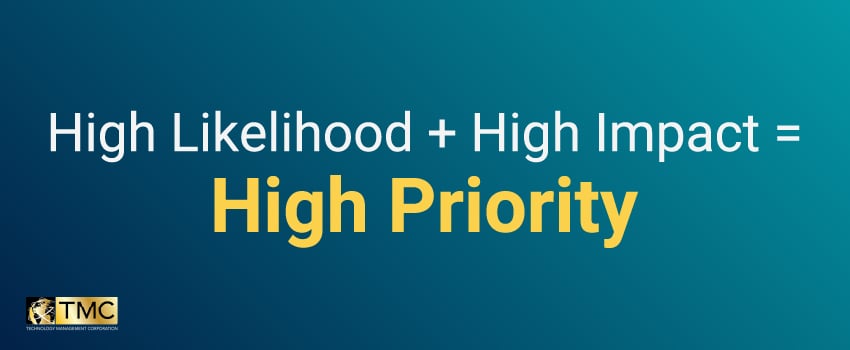
- Risk: The combined function of likelihood and impact. If a threat has a high likelihood and a high impact, it’s a high priority.
These concepts provide the analytical framework that makes a cybersecurity risk assessment actionable rather than academic.
What Is the Cybersecurity Risk Assessment Process?
A properly structured cybersecurity risk assessment process follows a logical progression. It begins by understanding what you have, then identifies what threatens it, measures the exposure, and develops a prioritized plan to reduce it. This type of structured approach can help you make sure nothing falls through the cracks and that findings reflect organizational reality rather than theoretical scenarios.
At TMC, our GRC, Security & Privacy practice follows a vendor-neutral methodology that aligns with leading frameworks, including NIST SP 800-30, ISO 27005, and CIS Controls. The goal is to give your organization a clear, defensible picture of risk – not a generic report that sits on a shelf.
6 Cybersecurity Risk Assessment Steps
Following these six cybersecurity risk assessment steps can keep your organization from getting lost in complexity or missing critical exposures.
Step 1: Define the Scope and Objectives
Every assessment should start with a clear definition of scope. What systems, processes, data types, and business units are included? What are you trying to protect, and why? Scope boundaries determine both the depth of the assessment and the relevance of its findings.
Skipping this step or defining scope too broadly or too narrowly is one of the most common reasons assessments produce results that are hard to act on.
Step 2: Identify and Inventory Your Assets
You can’t protect what you don’t know you have. Asset identification requires a thorough inventory of your information systems, data stores, hardware, software, and the people and processes that interact with them.
For each asset, make sure to document what it is and where it lives, the data it processes and how sensitive that data is, who has access to it, and how critical it is to business continuity if it’s compromised.
This inventory also serves as a baseline for ongoing monitoring and future assessments. Organizations with complex or legacy environments often uncover shadow IT, unsupported systems, or forgotten data repositories during this phase – each representing unmanaged risk.
Step 3: Identify Threats and Vulnerabilities
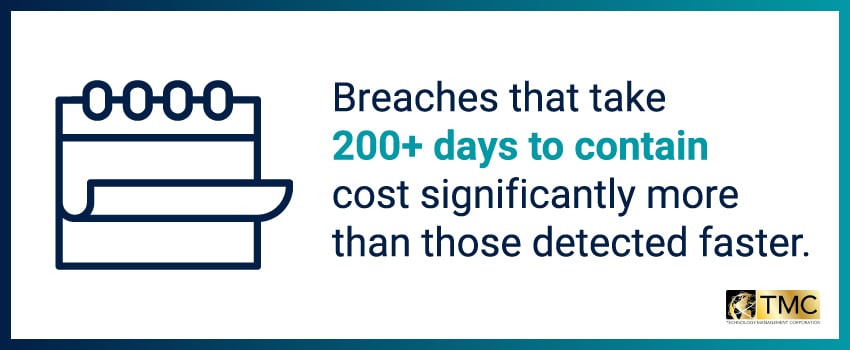
Breaches that take over 200 days to identify and contain cost organizations significantly more than those detected faster,1 highlighting the financial value of prioritizing detection capabilities.
Effective threat identification relies on multiple sources, including vulnerability scanning tools that identify unpatched software or network exposure, and threat intelligence feeds that track emerging attack tactics in your industry.
Conducting policy and process reviews can also surface gaps in access management, incident response, or vendor oversight, while performing interviews with IT staff and end users may help to uncover risks that tools alone won’t surface.
The combination of technical scanning and human intelligence is what separates a thorough assessment from a compliance checkbox.
Step 4: Analyze and Prioritize Risk
Not every vulnerability represents equal risk. Once threats and vulnerabilities are identified, each must be evaluated against two dimensions: the likelihood it will be exploited and what the impact would be if it is. The combination of these two factors produces a risk rating – typically expressed as low, medium, high, or critical.
Risk scoring can be:
- Qualitative, which is based on expert judgment and relative ranking.
- Quantitative, which uses financial modeling to assign dollar values to potential losses.
- Hybrid, combining qualitative and quantitative scores for a comprehensive view.
The output of this step is a clear, ranked list of vulnerabilities, their associated threats, and the business context that makes them more or less critical to address.
Step 5: Evaluate Existing Controls and Identify Gaps
Every organization has some security controls already in place. The question is whether those controls are strong enough to reduce your identified risks to an acceptable level.
Map your existing controls to identified risks and evaluate their effectiveness. You may find that controls that exist on paper but aren’t enforced, or gaps between what a control is designed to do and what it actually protects against in practice.
Identifying these gaps is where the cybersecurity risk assessment process delivers some of its greatest value. It moves the conversation from “do we have security tools?” to “how do these tools reduce our risk?”
Step 6: Document Findings and Build a Risk Treatment Plan
The final step is translating assessment findings into an actionable plan. The risk treatment plan assigns each identified risk to one of four response strategies:
- Mitigate: Implement controls to reduce the likelihood or impact of the risk.
- Transfer: Shift risk to a third party through cyber insurance or contractual agreements.
- Accept: Formally acknowledge the risk and monitor it when the mitigation costs exceed the potential impact.
- Avoid: Eliminate the activity or asset that creates the risk where feasible.
For each finding, the plan should identify the owner, the recommended action, the timeline for remediation, and the metrics that will confirm the risk has been reduced. This gives leadership a clear roadmap – not a report that raises concerns without charting a path forward.
Mistakes That Undermine a Cybersecurity Risk Assessment
Even organizations that complete a formal assessment sometimes find that it doesn’t deliver the value they expected. The most common reasons include:
- Treating the assessment as a one-time event rather than a recurring process that keeps pace with your evolving technology environment and threat landscape.
- Scoping too narrowly and missing third-party risk, remote access exposure, or shadow IT.
- Relying solely on automated scanning without process, policy, and human factor analysis.
- Producing findings without a clear, prioritized remediation plan that assigns ownership and accountability.
- Conducting the assessment internally without independent validation, resulting in missed blind spots that internal teams are too close to see.
The mechanics of a risk assessment are only as effective as the expertise behind them. Knowing how to conduct a cybersecurity risk assessment requires an understanding of how risks interact across your technology environment, how your industry’s threat landscape is evolving, and how to connect findings to the business decisions that matter to your leadership.
That’s why many organizations choose to engage an experienced consulting partner rather than tackle the process entirely in-house. The right partner doesn’t just identify risks – they help you understand what those risks mean for your mission, your compliance posture, and your long-term technology strategy.
Take a Clearer Look at Your Cybersecurity Risk With TMC
Understanding your cybersecurity risk exposure is one of the most valuable investments a technology leader can make. But the process only delivers results when it’s conducted with the right methodology, the right expertise, and a clear commitment to turning findings into action.
At TMC, we built our GRC, Security & Privacy consulting services on three decades of experience working with complex, regulated environments – from government agencies and healthcare networks to airports, universities, and enterprise organizations. We bring no vendor allegiances to the table. Our recommendations are driven entirely by your risk profile and your objectives.
For organizations managing infrastructure that’s already under pressure – whether from aging systems, cloud migration, or growing compliance mandates – our Core Infrastructure audit and optimization services can complement a risk assessment with a broader view of how your technology environment supports or introduces risk.
Ready to get started? Contact our team today. We’ll help you get clarity on your risk posture and a path forward that’s built around your mission, not a vendor’s agenda.
Sources: