

Slow application performance. Frustrated remote users. Bandwidth bills that keep climbing. For many organizations, these aren’t isolated complaints – they’re symptoms of a wide area network (WAN) that’s working against the business instead of for it.
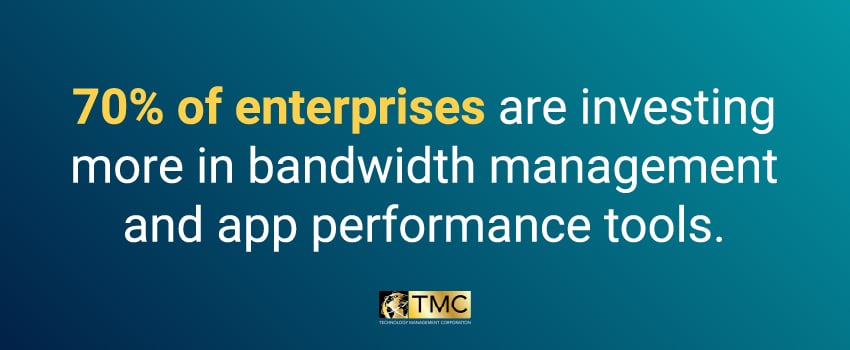
WAN optimization is designed to fix exactly that. And with 70% of enterprises increasing their investment in bandwidth management and app performance tools, including WAN optimization,1 business leaders who don’t understand its importance are likely already falling behind.
This guide breaks down how WAN optimization works, when it’s needed, and how it compares to newer approaches like SD-WAN – so you can make informed decisions about your network strategy.
What Is WAN Optimization?
WAN optimization includes several technologies and techniques that improve the overall performance of data transmission across a wide area network.
WANs connect distributed locations like branch offices, data centers, cloud environments, and remote users – usually over MPLS circuits or broadband connections that introduce latency, congestion, and bottlenecks. WAN optimization addresses these issues by reducing the amount of data that travels the network, prioritizing the traffic that matters most, and compensating for the latency that can’t be eliminated.
WAN optimization solutions are typically deployed as hardware appliances, virtual appliances, or cloud-based services, and they operate at both ends of a network connection to maximize the benefit of each technique.
Where WAN Optimization Fits in Your Network Architecture
WAN optimization sits between your local network (LAN) and the WAN connection itself.
Devices at each site intercept traffic, apply optimization techniques, and transmit a compressed, deduplicated, or protocol-adjusted data stream to the corresponding device at the other end. The receiving appliance then reconstructs the original traffic for delivery to the end user or application.
This architecture makes WAN optimization largely transparent to end users and applications, which is part of its value. It improves bandwidth management and app performance without requiring changes to your existing software or end-user workflows.
Why WAN Optimization Is Required
The need for WAN optimization is driven by the practical realities of how modern organizations operate. As application environments have grown more distributed and more demanding, the performance gaps in WAN environments have become harder to ignore.
Here’s why WAN optimization is required for many organizations:
- Latency-sensitive apps suffer over long distances. Voice, video, and real-time collaboration tools are particularly vulnerable to high latency and jitter. Even a few hundred milliseconds of delay can make these applications unusable.
- Chatty protocols amplify the cost of latency. Many enterprise applications – including older file-sharing protocols like CIFS/SMB – require frequent round-trip acknowledgments. Each round trip is multiplied by WAN latency, degrading performance far beyond what bandwidth alone would explain.
- Bandwidth is expensive and finite. Business networks experience up to 45% growth in average bandwidth usage annually.1 While buying more WAN bandwidth is a valid solution in some cases, it can become cost-prohibitive as your data volumes grow. Optimization reduces consumption, often deferring or eliminating the need for expensive circuit upgrades.
- Remote and branch office users expect consistent performance. A workforce spread across multiple sites or working remotely needs reliable access to centralized network resources. When your WAN can’t perform, it translates directly into lost productivity and user frustration.
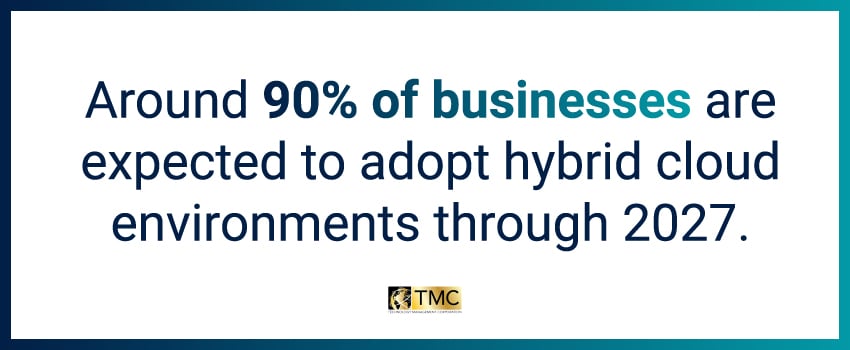
- Cloud adoption introduces new performance variables. Around 90% of businesses are expected to adopt hybrid cloud environments through 2027.2 But as more workloads shift to SaaS and IaaS platforms, traditional WAN architectures are struggling to route these high volumes of internet-bound cloud traffic efficiently.
For organizations managing distributed infrastructure, these pressures compound quickly. TMC’s network infrastructure consulting can help you assess where these pain points are sharpest and which interventions will deliver the most meaningful improvement.
How Does WAN Optimization Work? WAN Optimization Techniques
Understanding how WAN optimization works requires looking at the specific mechanisms it uses to address the core constraints of wide area networking. Most WAN optimization solutions combine several techniques to produce cumulative performance gains, including:
Data Deduplication and Compression
Deduplication identifies and eliminates redundant data segments before they’re transmitted across the WAN. Rather than sending the same data block multiple times, the optimization appliance sends a reference token on subsequent transfers. The receiving appliance reconstructs the full data from its local cache.
Compression works alongside deduplication, applying algorithms to reduce the size of data that hasn’t already been deduplicated. The two techniques together address both repetitive patterns and compressible content.
Protocol Optimization and Acceleration
Many enterprise protocols were designed for low-latency LAN environments and perform poorly over high-latency WAN connections. Protocol optimization – sometimes called protocol acceleration – modifies how these protocols behave to compensate for WAN conditions.
Optimization appliances use a technique called read-ahead and write-behind caching, combined with local protocol termination. Rather than waiting for each round-trip acknowledgment across the WAN, the local appliance handles acknowledgments and pre-fetches anticipated data, dramatically reducing the impact of latency on file operations.
Similar techniques are applied to HTTP, FTP, MAPI (Microsoft Exchange), and other common enterprise protocols. The result is application performance that more closely resembles LAN behavior, even over long-distance WAN connections.
Traffic Shaping and Quality of Service (QoS)
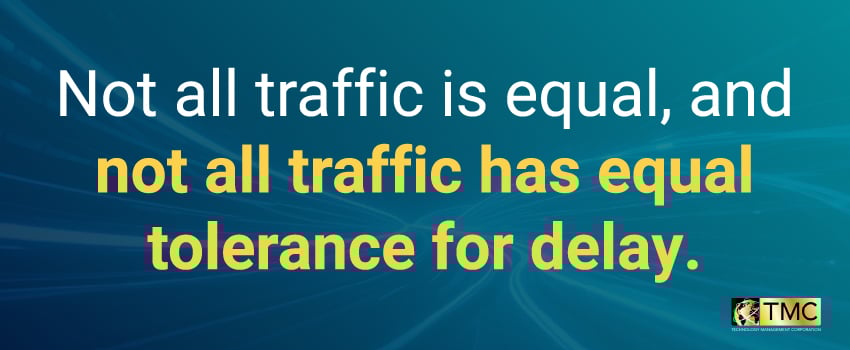
Not all traffic is equal, and not all traffic has equal tolerance for delay. Traffic shaping and QoS policies ensure bandwidth is allocated according to your organization’s priorities – giving latency-sensitive traffic like voice and video the headroom it needs, while throttling lower-priority traffic during peak hours.
WAN optimization appliances typically offer granular policy controls that allow IT teams to classify traffic by app, user, time of day, or destination, and traffic shaping and QoS rules accordingly. This prevents any single application or user from consuming disproportionate bandwidth at the expense of critical workloads.
TCP Optimization and Forward Error Correction
TCP wasn’t designed for high-latency or lossy network conditions. Its congestion control mechanisms can underperform on high-latency WAN connections – throttling throughput far below what the available bandwidth should support.
WAN optimization addresses this through TCP optimization techniques that modify how the protocol manages window sizing, acknowledgment behavior, and retransmission. Some solutions also apply Forward Error Correction (FEC), which adds redundant data to transmissions so that packet loss can be recovered without retransmission.
Caching and Local Content Delivery
Caching stores frequently accessed content locally at the branch or remote site, so it can be served from the local appliance rather than retrieved across the WAN on every request. This technique is especially effective for web content, software distribution, and read-heavy file access patterns.
For large organizations with many branch locations accessing the same centralized resources, caching can dramatically reduce the volume of redundant traffic traversing the WAN while simultaneously improving the end-user experience.
SD-WAN vs. WAN Optimization: Understanding the Difference
As software-defined networking has matured, SD-WAN has become one of the most discussed topics in enterprise network strategy – and one of the most common sources of confusion when it comes to WAN optimization. The two are related, but they’re not the same thing.
What SD-WAN Does
SD-WAN (Software-Defined Wide Area Networking) is a type of network architecture that abstracts the underlying transport layer – MPLS, broadband, LTE, or any combination – and uses software-defined policies to route traffic across those connections.
SD-WAN’s core strengths include:
- Dynamic path selection that routes traffic over the best-performing available connection in real time.
- Centralized visibility and policy management across all network edges from a single control plane.
- Cost reduction by supplementing or replacing expensive MPLS circuits with broadband alternatives.
- Simplified deployment and management for distributed, multi-site environments.
SD-WAN enables organizations to use multiple, lower-cost internet connections in place of expensive MPLS circuits, while maintaining intelligent traffic routing based on application performance requirements.

How WAN Optimization Differs
WAN optimization focuses on what happens to traffic after you decide where to send it. It doesn’t change routing decisions. Instead, it reduces the data volume being routed and accelerates protocols that perform poorly over distance to ensure your network is using bandwidth as efficiently as possible.
SD-WAN and WAN optimization are not mutually exclusive. More than 62% of global organizations have already integrated some form of WAN optimization into their IT infrastructure1 with many of these deployments including SD-WAN integration. SD-WAN handles intelligent routing across hybrid transport connections, while WAN optimization improves application performance across those connections.
Not sure which is right for your environment? At TMC, our network infrastructure team takes a vendor-neutral approach to this evaluation, recommending solutions based on your actual requirements – not based on what a vendor has to sell.
6 Signs Your Organization Needs WAN Optimization Now
Performance problems don’t always announce themselves clearly. Sometimes they show up as vague complaints about slow applications. Other times, they’re visible in bandwidth utilization reports or circuit cost trends.
Here are the signs that might mean your WAN optimization deserves a serious look:
- Branch office users consistently report degraded application performance compared to headquarters users on the same systems.
- File transfers, backups, or replication jobs are taking longer than acceptable windows allow, impacting operations or recovery time objectives.
- Voice and video are low quality despite adequate bandwidth – pointing to latency and jitter rather than raw capacity as the root cause.
- WAN bandwidth utilization is consistently high, and circuit upgrade costs are becoming difficult to justify relative to business value.
- A cloud migration or SaaS adoption has changed your traffic patterns and created new performance bottlenecks that weren’t present before.
- Your organization is expanding to new sites or geographies, and you want to ensure performance standards are maintainable without proportional increases in WAN spend.
These patterns often indicate that your network infrastructure is constraining business operations rather than enabling them.

What To Expect From a WAN Optimization Engagement
If you’ve decided that WAN optimization is worth evaluating, it’s helpful to understand what a well-structured engagement looks like. The process should be grounded in data, not assumptions.
A structured WAN optimization engagement typically involves:
Baseline Assessment
Measure your current WAN performance, bandwidth utilization, application response times, and circuit costs to establish a clear picture of where you are today.
Traffic Analysis
Identify which applications and protocols are consuming the most bandwidth and which are most sensitive to latency. This step is essential for determining where optimization techniques will have the greatest impact.
Solution Design
You’ll need to choose the right combination of techniques and technologies – deduplication, protocol acceleration, QoS, SD-WAN, or a hybrid approach – based on the actual data collected, not vendor defaults.
Implementation and Validation
Deploy your WAN optimization solution and start measuring performance outcomes against the pre-optimization baseline to confirm your investment delivered the expected results.
Ongoing Monitoring
Establish visibility into WAN performance over time so that you can address changes in traffic patterns, app usage, or network conditions before they become problems.
WAN Optimization and Network Infrastructure Consulting FAQs
Ready To Get More From Your WAN Investment?
WAN performance problems rarely resolve themselves. Whether you’re dealing with chronic application latency, rising circuit costs, or a network architecture that’s struggling to keep up with cloud adoption, WAN optimization – applied strategically – can deliver measurable improvements without requiring a wholesale infrastructure replacement.
At TMC, we’ve helped organizations design, optimize, and manage high-performance network environments since 1987. Our network audits and optimization engagements build a clear picture of where optimization will deliver real value based on your actual requirements, not a product catalog.
If you’re ready to evaluate WAN optimization for your organization, contact TMC today. We’ll help you understand what’s driving your performance challenges, evaluate the right solutions, and implement changes that hold up over time.
Sources: