

TL;DR
-
AI governance is the set of policies, roles, and controls that help organizations use AI responsibly, securely, and in line with compliance requirements.
-
Strong governance reduces risks such as poor data handling, shadow AI, weak accountability, and inconsistent oversight across teams.
-
Effective programs assign clear ownership across leadership, IT, security, compliance, and business stakeholders rather than leaving AI oversight to one team alone.
-
To make governance work in practice, businesses should align to relevant frameworks, monitor AI performance and usage over time, and adapt controls as regulations and risks evolve.
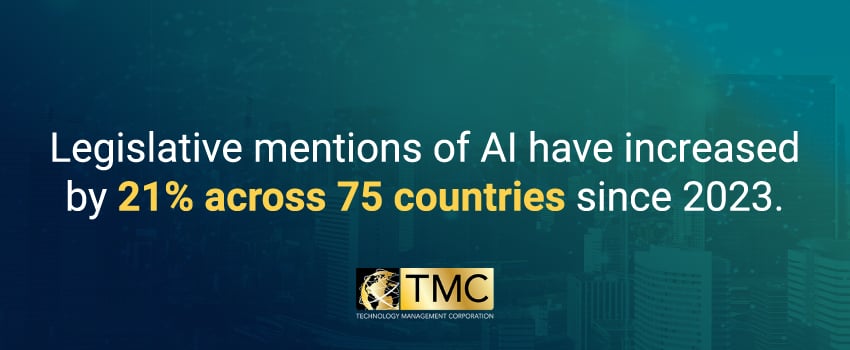
AI is reshaping industries, but it’s also drawing unprecedented attention from policymakers. U.S. federal agencies introduced 59 AI-related regulations in 2024, and legislative mentions of AI have increased by 21% across 75 countries since 2023.1 Keeping up with policy changes will require organizations to adopt frameworks that ensure AI is both effective and compliant.
AI governance provides this structure. It outlines clear policies, roles, and controls to guide how a business will develop and use AI. Without it, businesses risk falling behind regulatory expectations or adopting tools that erode customer trust.
At TMC, we help organizations build AI governance frameworks that balance innovation with responsibility. Read on to learn what AI governance means, why it matters, and which best practices will help your organization adopt AI responsibly.
What Is AI Governance?
AI governance refers to the processes and controls that guide how an organization adopts AI. It ensures AI is used ethically while providing a consistent framework for data handling, risk management, and accountability.
Effective AI governance isn’t just about limiting risk; it also builds trust by establishing clear expectations for how your business will use AI tools. These expectations are grounded in a set of principles that provide the foundation for any governance model, which we’ll explore below.
AI Governance Principles
While your governance model should be tailored to your organization’s operations and goals, there are a few common principles you can use to form the foundation.
- Transparency: AI decisions and data usage must be explainable and auditable.
- Accountability: Clear roles should be assigned to ensure oversight across all AI projects.
- Security: Security measures like access controls and risk assessments help protect against misuse.
- Fairness: Governance policies need to address potential bias in data and AI models.
- Compliance: Frameworks should align with regulatory requirements and industry standards.
At TMC, we integrate these principles into our AI transformation consulting to help organizations establish an ethical foundation before scaling AI initiatives. We focus on your people, processes, and technology to ensure your adoption is responsible and sustainable.
Who Is Responsible for AI Governance?
AI governance works best as a shared responsibility across the organization. While leadership sets direction, effective oversight usually involves input from IT, security, legal, compliance, data teams, and the business stakeholders using AI in practice. That cross-functional structure helps organizations address not just model risk, but also the policy, security, and operational issues that come with real-world AI adoption.
Executive Oversight and Accountability
Senior leadership or a governance committee should set the organization’s approach to AI risk, approve policies, and assign accountability across initiatives. This creates a clearer process for reviewing new use cases, aligning them with business goals, and making sure governance decisions are documented rather than handled inconsistently from team to team.
Cross-Functional Operational Ownership
Once direction is set, the day-to-day work of AI governance typically falls across several teams. IT and security help enforce access, data, and environment controls. Legal and compliance translate regulatory obligations into practical requirements. Business stakeholders help define appropriate use and validate whether AI outputs are fit for purpose. At TMC, we see this alignment across people, process, and technology as essential to building an AI governance model that is both responsible and workable.
Why Is AI Governance Important?
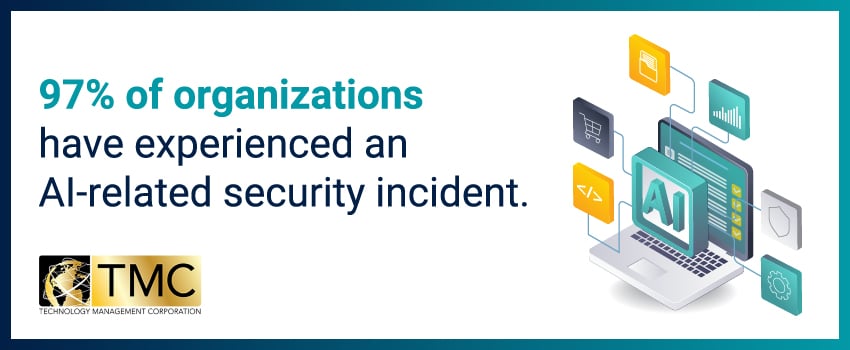
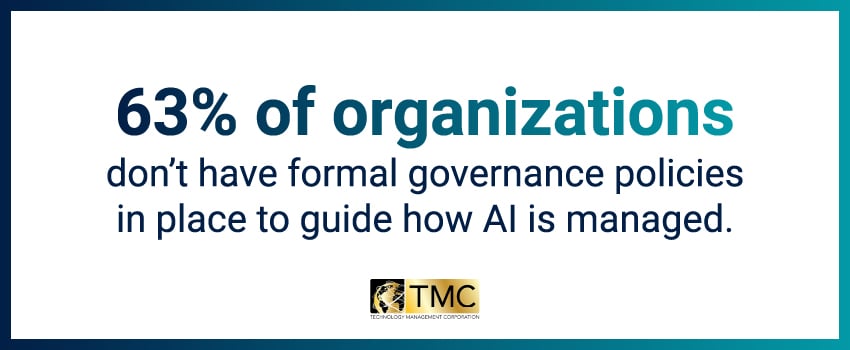
AI opens doors to new opportunities, but it also creates risks if not managed carefully. IBM’s 2025 Cost of a Data Breach Report found that 97% of organizations have experienced an AI-related security incident, but 63% still don’t have formal governance policies in place to guide how AI is managed.2 That gap leaves businesses exposed to potential compliance violations, data breaches, and even inconsistent practices across teams.
Currently, laws like GDPR and HIPAA set strict standards for how businesses can handle data – and new AI-specific regulations are emerging all the time. Falling short of these standards can mean not just paying fines, but also suffering reputational damage if customers lose trust in how you’re handling their data.
Strong governance gives organizations a way to get ahead of these challenges. It ensures sensitive data is protected, compliance requirements are met, and AI models are monitored for issues like bias or accuracy.
Which AI Governance Frameworks & Regulations to Consider
There is no single framework that fits every organization, but there are several widely used reference points that can help businesses shape a more consistent AI governance program. The most practical approach is usually to combine a risk management framework, a set of guiding principles, and the regulatory requirements that already apply to your business and industry.
NIST AI Risk Management Framework
The NIST AI Risk Management Framework gives organizations a practical structure for managing AI risk through four core functions: Govern, Map, Measure, and Manage. It is especially useful for building internal processes around oversight, evaluation, and ongoing risk response.
OECD AI Principles
The OECD AI Principles provide a broader foundation for trustworthy AI. They focus on AI that is innovative, trustworthy, and respectful of human rights and democratic values, making them a helpful guide for setting expectations at the policy level.
EU AI Act and Existing Compliance Requirements
The EU AI Act introduces a risk-based legal framework for AI, with different obligations depending on how an AI system is used and the level of risk it creates. Even where it does not apply directly, it is influencing how businesses think about AI oversight, documentation, and accountability. At the same time, organizations still need to align AI use with existing privacy, security, and sector-specific compliance requirements.
What AI Governance Challenges Do Businesses Face?
The benefits are clear, but building an effective governance framework isn’t always simple. You may face challenges like:
Data Readiness Gaps
Many organizations have unstructured, unclassified, or siloed data that limits their ability to safely deploy AI.
Lack of Standards
As AI regulations evolve, businesses may lack a clear reference point for developing frameworks.
Resource Constraints
Internal IT and compliance teams may not have the bandwidth to manage AI new governance processes alongside their existing responsibilities.
Shadow AI
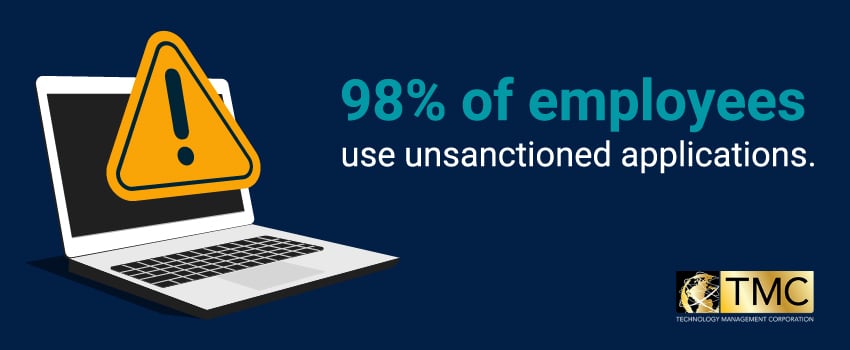
A 2025 survey by Varonis revealed that 98% of employees use unsanctioned applications.3 These AI tools operate without IT or compliance oversight, which can create security and data privacy risks.
5 AI Governance Best Practices
Ready to build an AI governance framework for your business? Here are a few best practices we recommend keeping in mind:
1. Establish Policies and Roles
First, you need to define acceptable use policies for AI and set up a governance committee to ensure oversight. Assigning clear responsibilities at the start of your AI initiatives can help you avoid fragmented decision-making and create accountability across business units.
2. Conduct Risk Assessments
Determine where AI can help improve your operations most, while assessing risks like model bias and poor data quality. These assessments will provide a foundation for prioritizing your AI projects and allocating resources effectively.
3. Ensure Data Readiness
Data is central to AI, which means organizations need processes for data classification, access, and protection to ensure its integrity and reduce the risk of exposure or misuse.
4. Build Private and Secure AI Environments
Secure enclaves or private large language models (LLMs) can help you reduce risk while scaling AI across your operations. Conduct security assessments, penetration testing, and ROI analysis to make sure your AI projects stay safe and financially sound.
5. Continuously Monitor and Adapt
AI governance shouldn’t be static. Make sure to perform reviews and audits regularly to keep your frameworks aligned with changing regulations, technologies, and organizational goals.
What Should an AI Governance Program Monitor?
AI governance does not stop once policies are written or a model is approved. Organizations need ongoing visibility into how AI is performing, how it is being used, and whether it is staying within the limits the business originally set. Without that monitoring, governance can quickly become outdated or exist only on paper.
Performance, Drift, and Output Quality
AI systems should be monitored for accuracy, consistency, and signs that performance is changing over time. A model that initially works well may become less reliable as business conditions, inputs, or usage patterns shift. Ongoing review helps organizations identify when a system needs tighter oversight, retraining, or a change in scope.
Bias, Explainability, and Policy Alignment
Governance should also track whether AI systems continue to operate in ways that are fair, explainable, and consistent with internal policy. That includes reviewing whether outputs can be understood where needed, whether use cases remain within approved boundaries, and whether teams are relying on AI in ways the organization did not originally intend.
Access Controls, Data Handling, and Business Impact
An effective program should monitor who can access AI tools, what data they can reach, and whether meaningful logs exist for review and audit. These controls are critical because AI risk is often driven as much by the surrounding environment as by the model itself. Organizations should also review whether AI is delivering value against business goals, so governance supports both responsible use and measurable outcomes. NIST’s AI RMF reinforces this need for ongoing governance across the broader AI lifecycle.
AI Governance FAQs
What is AI governance?
AI governance is the set of policies, controls, roles, and review processes that guide how an organization develops, adopts, and oversees AI. Its purpose is to help businesses use AI responsibly by addressing issues such as accountability, security, fairness, compliance, and ongoing monitoring.
Why is AI governance important?
AI governance is important because it helps organizations reduce the risks that come with AI adoption while building a more consistent foundation for responsible use. Without governance, businesses may struggle with issues such as unclear ownership, poor data handling, security gaps, shadow AI, and difficulty keeping pace with evolving regulatory expectations.
How do you implement AI governance?
Implementing AI governance usually starts with defining acceptable use policies, assigning clear ownership, and identifying which AI use cases carry the most risk. From there, organizations can establish review processes, strengthen data and access controls, document accountability, and create a plan for ongoing monitoring so governance keeps pace with how AI is actually being used.
How does AI governance support trustworthy AI?
AI governance supports trustworthy AI by creating clear expectations for how systems should be designed, deployed, reviewed, and monitored over time. When organizations put guardrails around data use, access, transparency, oversight, and risk response, they are better positioned to use AI in ways that are safer, more consistent, and easier to justify to customers, employees, and regulators.
Who should be involved in AI governance?
AI governance should involve more than IT alone. In most organizations, it requires input from leadership, security, legal, compliance, data teams, and the business stakeholders responsible for the use case. That shared structure helps ensure AI decisions are evaluated from both a technical and operational perspective.
How often should AI governance be reviewed?
AI governance should be reviewed regularly, especially as regulations evolve, new use cases are introduced, or existing models change over time. The right cadence will vary by organization, but governance is most effective when reviews are ongoing rather than treated as a one-time project.
Why Partner With TMC for AI Governance
At TMC, we combine our decades of governance expertise with transformation strategy to guide clients through our proprietary 12-Step AI Transformation Roadmap. Built on the People, Process, and Technology methodology, our roadmap ensures your AI adoption:
- Aligns your people and process from the start with accountability, transparency, and trust built into every AI initiative.
- Closes compliance gaps and creates a trusted foundation that accelerates safe AI enablement across your organization.
- Provides ongoing value by setting measurable KPIs tied to your business goals and tracking AI performance against them.
As vendor-neutral consultants, our only agenda is enabling responsible innovation – not selling technology. Our experts work with you to deliver the right governance and transformation strategies for your environment, so you can rest easy knowing your AI initiatives will deliver measurable outcomes while protecting your brand and data.
Ready to build an AI governance framework that lets you innovate responsibly? Reach out to TMC today to get started.
Sources: